
UGSo CallMeBot Whatsapp
Since 0.1.4 the app is named UGSo CallMeBot Whatsapp. Existing profiles, MQTT topics and entity IDs are preserved. The separate UGSo CallMeBot Signal uses its own profiles and keys.
Experimental HA App 0.1.4 in the same repository as Blocks for HA. Complete DE/EN/FR interface and blocks, system language and light/dark/system appearance. Inspired by ioBroker.whatsapp-cmb; original UGSo implementation without ioBroker.
Fix in 0.1.1: Sending works without crypto.randomUUID, including HTTP Ingress. Restart the app and reload the page after updating. Request IDs use random bytes when available or a timestamp/counter fallback; they deduplicate requests and are not authentication tokens.
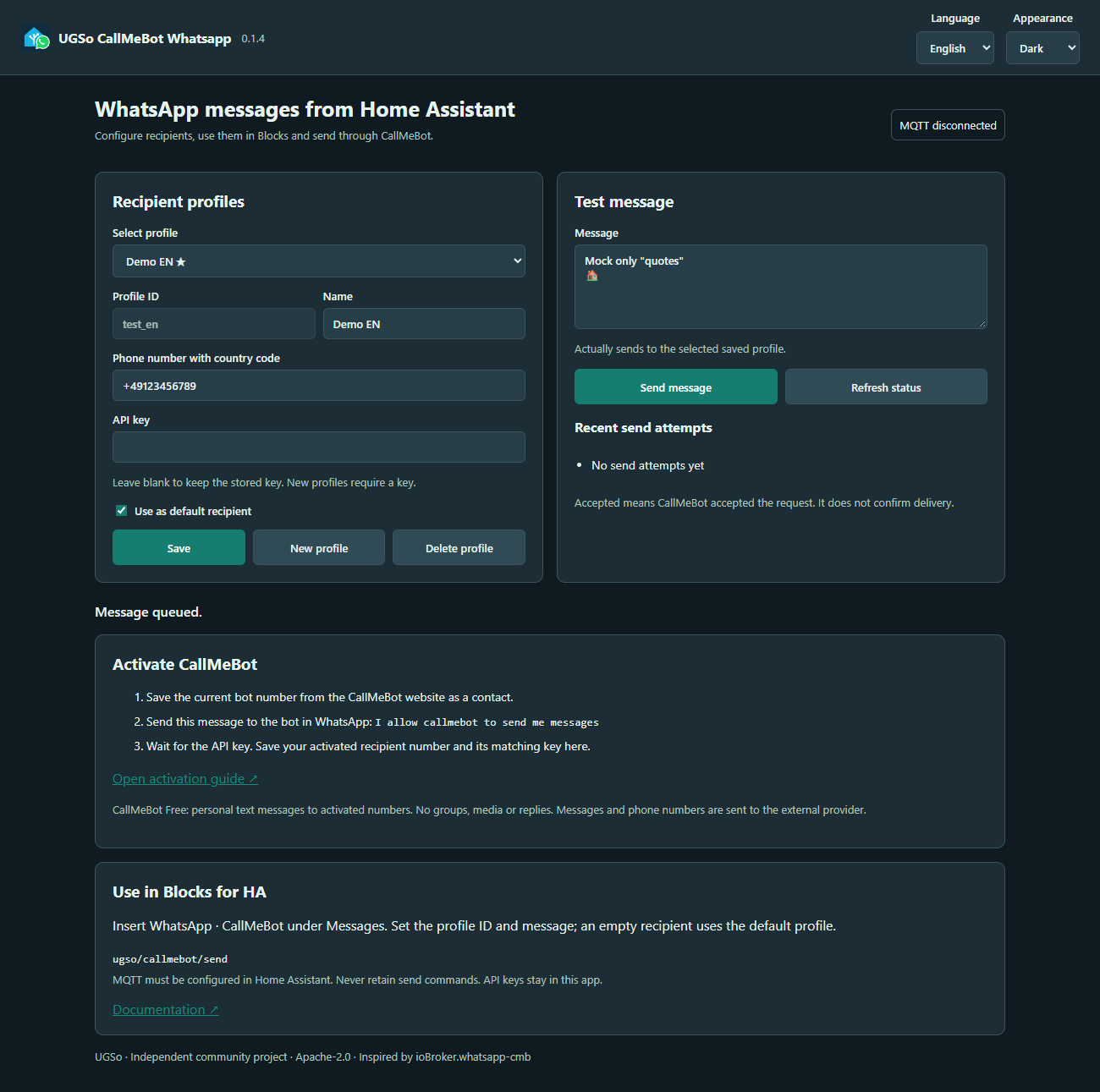
Installation and setup
- Add
https://github.com/rockbaer2007/ugso-ha-mqtt-addonsto the HA App Store. - Install UGSo CallMeBot Whatsapp, configure the MQTT broker and start the app.
- Open the Ingress UI. Supervisor MQTT credentials take priority; app options are the fallback.
- Activate your own recipient using the current bot number from the official activation guide. Send exactly
I allow callmebot to send me messages. - Save a profile ID, name, activated phone number with + and country code, and its matching API key. Select a default. Up to 16 profiles.
- The test button really sends to the selected saved profile; an empty selection uses the default.
A blank key field preserves the stored key. Keys are never returned to the UI. They remain in /data/profiles.json, outside Blockly, MQTT messages, browser storage and logs. This backend file is not encrypted and is included in HA backups.
CallMeBot Blockly block
Select saved profiles
With CallMeBot 0.1.2 and Blocks for HA 0.1.49, the profile field opens a searchable list of names, IDs and the default recipient. Refresh reloads the list. The block displays the name while projects and YAML retain the original ID. An empty ID uses the current default recipient.
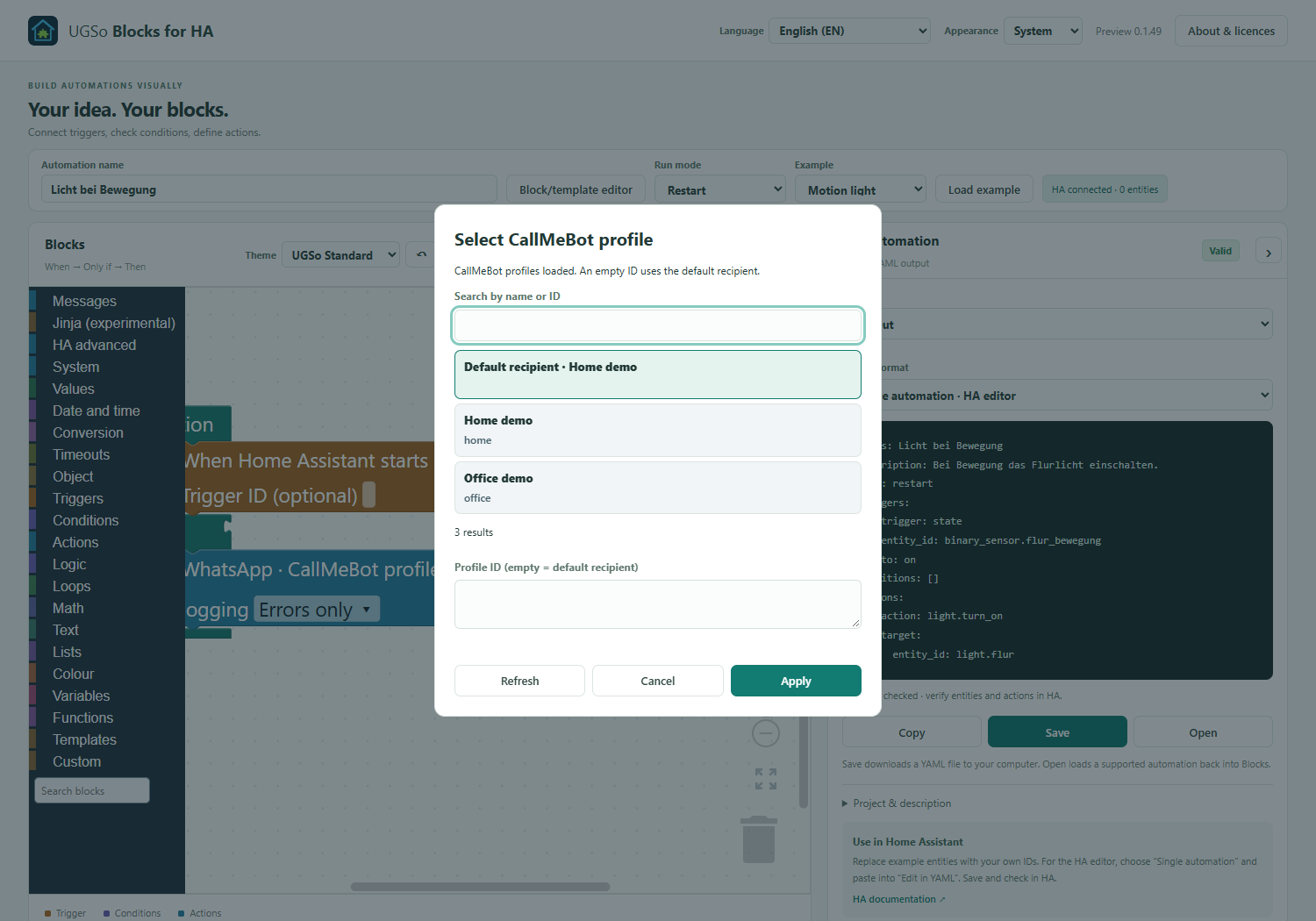
Update/restart both apps and reload Blocks. HA must connect to the broker and enable MQTT discovery with the standard homeassistant prefix. CallMeBot discovers a diagnostic sensor, normally sensor.ugso_callmebot_profiles; Blocks reads its catalog through the existing HA connection. Renaming this sensor is supported because its catalog marker identifies it. Technical basis: HA MQTT sensors and JSON attributes.
The retained ugso/callmebot/profiles catalog contains IDs, names, default profile, count and a marker only. No phone numbers, messages or API keys are published. Changes and MQTT reconnections refresh it. Profile names are visible in MQTT and HA.
If the app, MQTT, discovery or HA connection is unavailable, manual IDs and the default recipient remain usable. Deleted IDs are never silently replaced in projects; the app rejects sending to a missing profile.
Since Blocks for HA 0.1.48, under Messages → WhatsApp · CallMeBot.

Enter a profile ID or leave it empty for the default. Connect text, a variable or Jinja as the message. Logging: errors only, none or info. Exports native mqtt.publish, serializing JSON after template evaluation so quotes and newlines remain valid.
HA requires MQTT. JSON projects preserve the dedicated block. YAML imports back as a general HA/MQTT action.
Alternative: existing WhatsApp integration
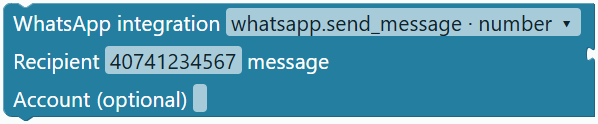
The second block calls FaserF’s WhatsApp integration. Configure its app URL and API token from the WhatsApp app once in the HA setup dialog. The integration manages this token; the block does not need it.
Select whatsapp.send_message · number for the older format, whatsapp.send_message · target for the current documentation, or notify.whatsapp if configured. Recipient: country code without +. Message: text/Jinja. The optional account is exported for whatsapp.send_message only. Matching YAML imports as the dedicated block; extra options remain in the general HA action.
This alternative requires neither the CallMeBot app nor a CallMeBot key. The existing integration handles installation and WhatsApp connectivity.
MQTT protocol and limits
- Send:
ugso/callmebot/send, QoS 0, retain false. - Payload:
{"profile":"default","message":"Hello from HA","loglevel":"errors"}. Empty/omitted profile uses the default. - Optional
request_id: one-hour deduplication per profile, keeping up to 1000 IDs. - Result:
ugso/callmebot/result, non-retained profile, request ID, status and timestamp; no message or key. - Availability:
ugso/callmebot/availability, retainedonline/offlinefor the broker connection. - Maximum 4000 characters, queue of 20, at least 10 seconds between attempts per profile. Faster commands are rejected, not delayed.
- No automatic provider retries or replay after restart. Retained send commands are rejected.
- One MQTT namespace/client ID: one app instance per broker. Restrict send-topic write permissions. This preview uses the internal broker; external TLS configuration is not included.
CallMeBot Free is for personal texts to your own activated numbers. No groups, media, replies or delivery confirmation. accepted confirms API acceptance only. Phone, key and text are transmitted over HTTPS to CallMeBot. Source: CallMeBot activation and API.
Verification
Docker build/start, mock-provider backend tests, MQTT protocol, DE/EN/FR UI, mobile layout and Blockly export were checked. Real WhatsApp delivery and HA Supervisor installation still require verification with your own setup. No real messages were sent.
Source and local test commands · Apache-2.0 · Independent community project.